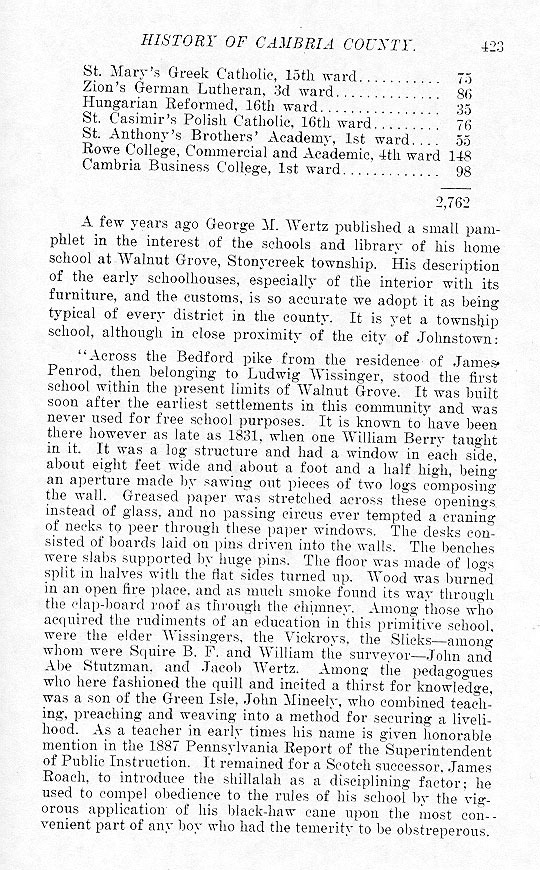
| St. Mary's Greek Catholic, 15th ward. |
75 |
| Zion's German Lutheran, 3d ward. |
86 |
| Hungarian Reformed, 16th ward. |
35 |
| St. Casimir's Polish Catholic, 16th ward. |
76 |
| St. Anthony's Brothers' Academy, 1st ward. |
55 |
| Rowe College, Commercial and Academic, 4th ward. |
148 |
| Cambria Business College, 1st ward. |
98 |
|
|
|
2,762 |
A few years ago George M. Wertz published a small pamphlet in the interest of the schools and library of his home school at Walnut Grove, Stonycreek township. His description of the early schoolhouses, especially of the interior with its furniture, and the customs, is so accurate we adopt it as being typical of every district in the county. It is yet a township school, although in close proximity of the city of Johnstown :
“Across the Bedford pike from the residence of James Penrod, then belonging to Ludwig Wissinger, stood the first school within the present limits of Walnut Grove. It was built soon after the earliest settlements in this community and was never used for free school purposes. It is known to have been there however as late as 1831, when one William Berry taught in it. It was a log structure and had a window in each side, about eight feet wide and about a foot and a half high, being an aperture made by sawing out pieces of two logs composing the wall. Greased paper was stretched across these openings instead of glass, and no passing circus ever tempted a craning of necks to peer through these paper windows. The desks consisted of boards laid on pins driven into the walls. The benches were slabs supported by huge pins. The floor was made of logs split in halves with the flat sides turned up. Wood was burned in an open fire place, and as much smoke found its way through the clap-board roof as through the chimney. Among those who acquired the rudiments of an education in this primitive school, were the elder Wissingers, the Vickroys, the Slicks – among whom were Squire B. F. and William the surveyor – John and Abe Stutzman, and Jacob Wertz. Among the pedagogues who here fashioned the quill and incited a thirst for knowledge, was a son of the Green Isle, John Mineely, who combined teaching, preaching and weaving into a method for securing a livelihood. As a teacher in early times his name is given honorable mention in the 1887 Pennsylvania Report of the Superintendent of Public Instruction. It remained for a Scotch successor, James Roach, to introduce the shillalah as a disciplining factor ; he used to compel obedience to the rules of his school by the vigorous application of his black-haw cane upon the most convenient part of any boy who had the temerity to be obstreperous.
|