|
| You are here: Cambria > Books > History of Cambria County, V.2 |
|
 |
|
| History of Cambria County, V.2 |
|
| 6 | HISTORY OF CAMBRIA COUNTY. | |
|
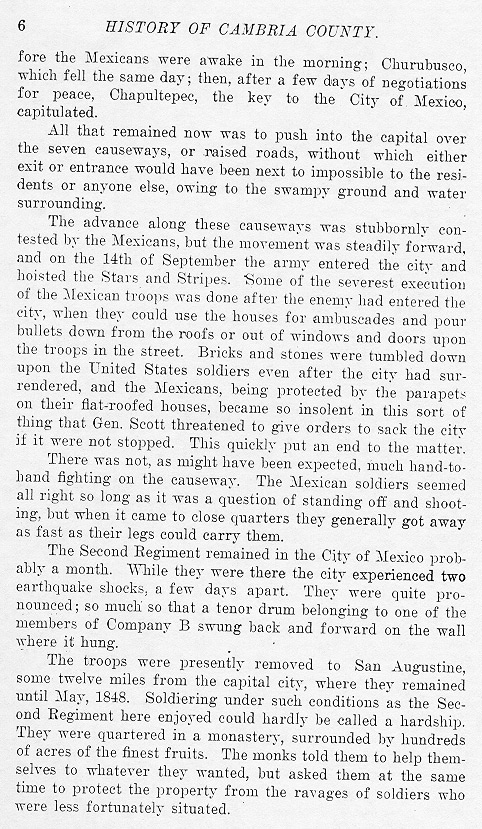
fore the Mexicans were awake in the morning; Churubusco, which fell the same day; then, after a few days of negotiations for peace, Chapultepec, the key to the City of Mexico, capitulated. All that remained now was to push into the capital over the seven causeways or raised roads, without which either exit or entrance would have been next to impossible to the residents or anyone else, owing to the swampy ground and water surrounding. The advance along these causeways was stubbornly contested by the Mexicans, but the movement was steadily forward, and on the 14th of September the army entered the city and hoisted the Stars and Stripes. Some of the severest execution of the Mexican troops was done after the enemy had entered the city, when they could use the houses for ambuscades and pour bullets down from the roofs or out of windows and doors upon the troops in the street. Bricks and stones were tumbled down upon the United States soldiers even after the city had surrendered, and the Mexicans, being protected by the parapets on their flat-roofed houses, became so insolent in this sort of thing that Gen. Scott threatened to give orders to sack the city if it were not stopped. This quickly put an end to the matter. There was not, as might have been expected, much hand-to-hand fighting on the causeway. The Mexican soldiers seemed all right so long as it was a question of standing off and shooting, but when it came to close quarters they generally got away as fast as their legs could carry them. The Second Regiment remained in the City of Mexico probably a month. While they were there the city experienced two earthquake shocks, a few days apart. They were quite pronounced; so much so that a tenor drum belonging to one of the members of company B swung back and forward on the wall where it hung. The troops were presently removed to San Augustine, some twelve miles from the capital city, where they remained until May, 1948. Soldiering under such conditions as the Second Regiment here enjoyed could hardly be called a hardship. They were quartered in a monastery, surrounded by hundreds of acres of the finest fruits. The monks told them to help themselves to whatever they wanted, but asked them at the same time to protect the property from the ravages of soldiers who were less fortunately situated. |
||
 |
Title Page | Contents | Image |  |